
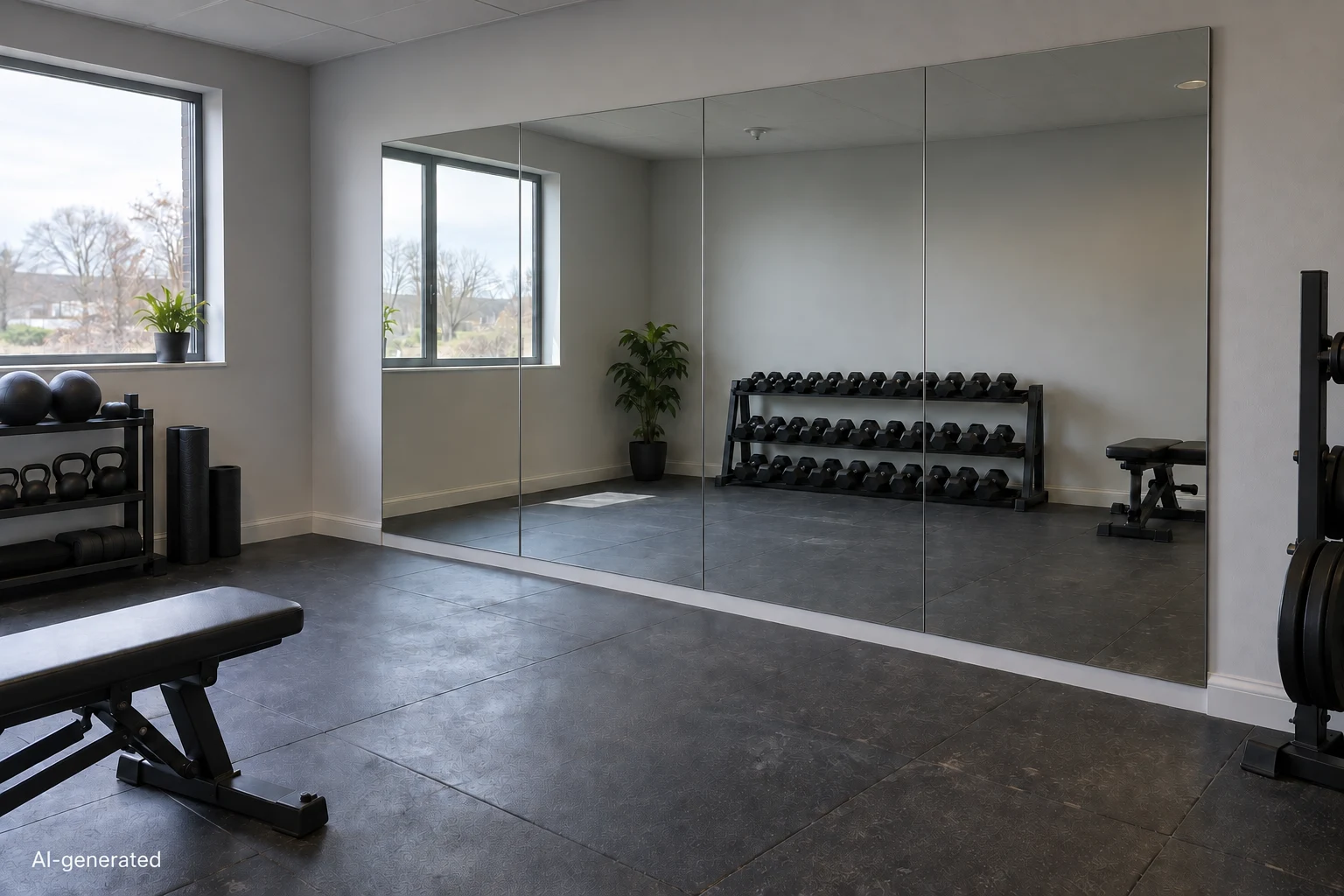
A lighter mirror can mean a simpler project
The reason to unpack the BOM is to find work you can simplify. NanoMirror replaces the glass reflective sheet with a lightweight film-based construction. Brisafe’s modular wall range is designed for assembly and later disassembly, giving operators an alternative to a permanently fitted glass wall (Brisafe n.d.b).
Same mirror area · Different weight
2 m² of mirror. A 2.5 kg NanoMirror module.
1 m × 2 m face area · Kilograms · One common 0–30 scale
- NanoMirror Air Series module2.5 kg
- 4 mm glass sheet20 kg
- 5 mm glass sheet25 kg
- 6 mm glass sheet30 kg
For the same area, the glass sheet alone weighs 20–30 kg at 4–6 mm thickness. That is a very different object to carry and position.
Compare three Air Series module sizes
Air Series · Module net weight
- 100 × 180 × 2 cm
- 2.2 kg
- 100 × 200 × 2 cm
- 2.5 kg
- 120 × 200 × 2 cm
- 3.2 kg
For a buyer, those weights are a reason to review the handling plan and ask whether the proposed modules reduce lifting equipment, crew effort, or access constraints. They are not a labor-saving percentage. The saving is established by the installer’s method and priced scope on your site.

A factory-sized NanoMirror module arrives without a glass sheet to cut or edge-finish on site. Lower mass can make internal moves, positioning and later removal easier to plan. Pair that with the right fixing method, and a mirror wall can become a more manageable fit-out task—not simply a lighter version of the same glass job.
Five ways to rethink how a mirror goes on the wall
A much lighter mirror opens up a wider choice of mounting methods. Brisafe identifies L-shaped brackets, hook-and-loop fasteners such as Velcro, specified 3M adhesive systems, French cleats and magnetic mounting as options across suitable NanoMirror configurations. The practical benefit is choice: a simple support, an adhesive fixing or a detachable connection can be selected around the room and how it will change (Brisafe 2026).
Brisafe’s public modular-wall page describes simple L-shaped components and later disassembly; its magnetic-mirror page describes a no-drill option using magnets and adhesive metal plates. This is the value to investigate before carrying over a heavy-glass installation allowance: can the chosen NanoMirror format reduce the handling and fitting work your project actually needs? (Brisafe n.d.b); (Brisafe n.d.a).
Choose the approved panel–fixing–wall combination
These are options, not interchangeable approvals for every size. Ask Brisafe to specify the exact panel, bracket or cleat, hook-and-loop or 3M product, magnet arrangement, contact area, wall finish and installation procedure. Brand names alone do not establish load capacity. Follow the specified surface preparation, curing and removal instructions; adhesive removal may affect finishes. Some adhesive or magnetic configurations can avoid drilling, but not every mounting method is no-drill.
Price the accepted wall, not the panel
Gross wall area, ordered product area, net finished area, and accepted mirrored area are different denominators. Yield loss, seams, openings, and spares can change the effective rate before a panel reaches the wall.
Lifecycle costing adds the relevant costs that differ between alternatives—from acquisition through operation, repair, replacement, and disposal (Kneifel and Webb 2022, 3, 40–41). For most bid awards, buyers should first make the initial installed cost comparable, then add lifecycle analysis where maintenance, replacement, or downtime could change the choice.
Figure 1 · Worked example
The cheaper panel can be the costlier wall
Panel 100 + other scope 130 = 230
Panel 150 + other scope 55 = 205
Bid B has a higher panel price but a lower comparable total: 205 versus 230.
Which cost measure should you use?
Quoted product divided by ordered product area. Useful for a component check, not for award.
All scope required for acceptance divided by net accepted finished area.
Installed cost plus relevant operating and failure costs over one stated study period.
Normalization formulaComparable installed cost per accepted m² = product + yield and spares + processing + attachments + logistics + wall work + installation + QA + priced warranty gaps, divided by net accepted finished mirrored area.
Glass and NanoMirror ask for different work
Compare two complete proposals for the same finished area. A conventional glass package may be right for a project; NanoMirror earns its place when the lighter, modular approach makes the work easier while meeting the agreed requirements.
Plan the glass package
Confirm pane weight, edge finishing, safety configuration, protective packaging, and safe handling. Define compatible supports and adhesives where specified. Glass can also be supplied prefabricated or mechanically mounted.
Plan around light, finished modules
Confirm module dimensions, net weight, joining details, and the matching mounting kit. Price the handling and assembly this system actually needs. Plan access to remove a module if the room or product needs attention.
Glass scope follows National Glass Association guidance; NanoMirror features are manufacturer-reported, not an independent comparison (National Glass Association 2022, 137); (Brisafe n.d.b). Verify every claim against the exact offered assembly.
The mirror can move with the room
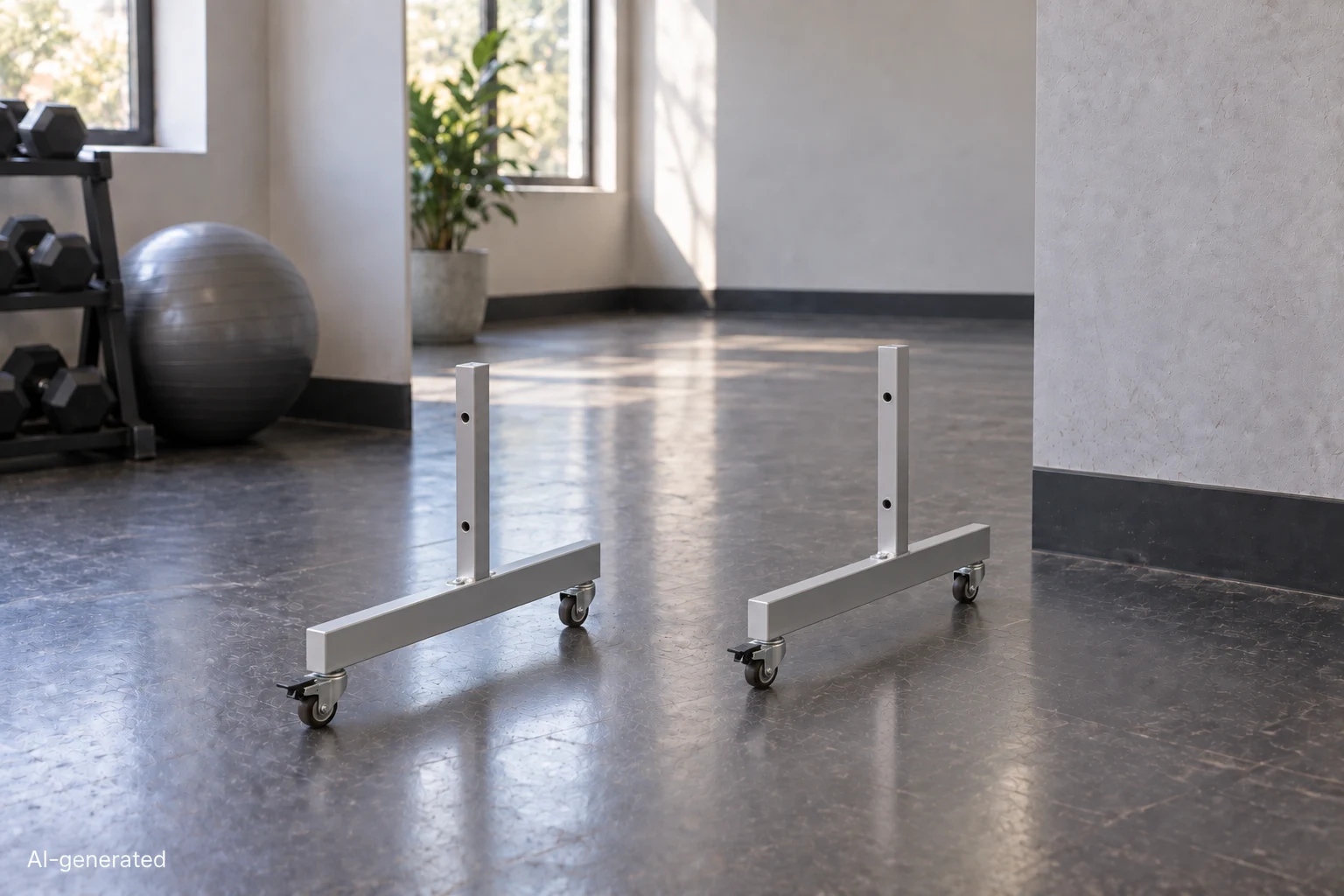
A rollaway format lets you reconsider the layout between classes without treating every change as a new wall project. Check floor clearance, base stability and castor instructions for the selected product.

See where the extra scope adds cost
The indexed example adds seven packages that are often absent, provisional, or divided among contracts. The numbers show the arithmetic and the questions to ask; they are not market prices or target margins.
Figure 2 · Worked example
From a panel quote of 100 to a total of 230
Index units · One common 0–250 scale
- Panel quote100 → 100
- Yield and spares+8 → 108
- Processing and attachments+22 → 130
- Packing, freight and handling+15 → 145
- Wall preparation+25 → 170
- Installation and protection+38 → 208
- QA and closeout+8 → 216
- Priced warranty gaps+14 → 230
In this scenario, the panel line is 43.5 percent of the accepted total. That percentage should never be transferred to a live project. The lesson is narrower: ranking the 100 before pricing the other 130 can reverse the apparent bid order.
A blank cell is not zero cost. It is unassigned cost.
Warranty wording allocates cost after award
A long warranty term does not guarantee a broad remedy. The useful questions are who can claim, what triggers coverage, what is supplied, where it is delivered, and who pays for every step needed to restore the wall.
Guardian Glass’s published mirror warranty illustrates the distinction: it is directed to the immediate customer, offers replacement at the original delivery point or a refund of the net purchase price, and excludes labor, replacement, installation, and fabrication costs (Guardian Glass 2022, 1). That is a product remedy, not a complete installed-system service.
Modular construction also gives you a practical service question: can the affected module be removed without rebuilding the whole wall? Ask for the actual procedure, available spares, lead time, and labor responsibility. Easier removal is useful only when the installation leaves that access available.
Assign all six remedy steps
- Diagnose: who inspects the reported defect and by when?
- Protect: who secures the area and adjacent finishes?
- Remove: who pays for labor, lifting, disposal, and access?
- Deliver: who covers replacement freight, duty, unloading, and handling?
- Reinstall: who restores the system and makes good?
- Retest: who proves the repaired wall meets the agreed acceptance criteria?
A project specification can require broader material, labor, repair, and replacement responsibility (Defense Health Agency 2021, 4–5). The executed contract decides who carries the gap.
Agree how the wall will be accepted
“Tempered,” “safety-backed,” “glassless,” and “shatterproof” are not interchangeable contractual outcomes. Ask for a named construction, test method, classification, laboratory, report number, date, and exact tested configuration.
Check which code and tests apply
In the United States, 16 CFR Part 1201 identifies specific architectural glazing applications within its scope; it should not be used as proof that every wall mirror is automatically covered. The adopted code, hazardous-location analysis, design documents, and authority having jurisdiction remain decisive (U.S. Consumer Product Safety Commission 2026, § 1201.1).
Visual quality also needs a payable definition. Uneven walls, forced fixing, lighting, joints, and handling can affect the installed reflection even when a product leaves the factory within its own standard (National Glass Association 2023, 1–2). Agree the following before award:
Open the five-point acceptance checklist
- Reference mock-up: production-equivalent materials, lighting, viewing positions, approver, and benchmark status.
- Layout and joints: panel sizes, seams, alignment, perimeter gaps, trims, and openings.
- Viewing protocol: distance, angle, orientation, light condition, reference grid or scene, and allowable variation.
- Defect limits: chips, scratches, coating damage, stains, punctures, and cleaning marks.
- Correction path: deadline, cost owner, replacement method, protection, reinspection, and final sign-off.
A six-step buying playbook
- 01Issue one measured scope basis
Use one definition of net accepted area and state who owns field verification.
- 02Make every bidder return the same BOM
Mark every package included, excluded, allowance, or not applicable.
- 03Normalize before ranking
Add documented owner allowances for excluded work and retain the raw quote beside the adjusted total.
- 04Match claims to the exact assembly
Check product codes, backing, frame, attachments, substrate, sizes, and test reports as one configuration.
- 05Compare lifecycle exposure consistently
Use the same study period and assumptions for cleaning, inspection, repair, replacement, downtime, and disposal.
- 06Award a responsibility model
Name who owns survey, substrate acceptance, installation, final acceptance, and every warranty-remedy step.
Put the framework to work
Use the full report for the reasoning and the workbook for the bid return.
Ten questions to resolve before the RFQ is final
- What net finished mirrored area will be used for payment?
- Who measures the wall and carries dimensional risk?
- What is the substrate, tolerance, moisture condition, and fixing capacity?
- What panel size, seam pattern, and mock-up establish the visual benchmark?
- What are the route, crate, unloading, storage, lifting, and work-hour constraints?
- Which cleaning agents, humidity, impact risks, and user behaviors must the surface withstand?
- Which code edition, classification, evidence, and authority approvals apply?
- What lifecycle period, timing assumptions, and downtime value will be used?
- How many compatible replacement units are required, and for how long must they remain available?
- Which legal entity owns every step from diagnosis through final retest?
A gym mirror wall can be easier to deliver than a panel-price comparison suggests. NanoMirror’s lightweight modules are worth evaluating for simpler handling, assembly, and later changes. Let the project-specific BOM show the value.
Explore the NanoMirror modular wall or discuss a layout and installation scope.
Published by NanoMirror Insights. NanoMirror is powered by Brisafe.
For commercial buyers
Understanding NanoMirror before you specify it
NanoMirror is Brisafe’s lightweight, film-based mirror category. Its reflective surface is not a conventional glass mirror sheet. Available formats include modular wall systems and movable mirrors. Choose the exact construction and mounting format for the project, not just the category name.
How is NanoMirror different from a glass gym mirror?
The key procurement difference is the construction and the work it requires. A lightweight finished module can simplify handling and avoid on-site glass cutting. Glass and film-based mirrors still need their own suitable mounting, surface care, visual acceptance criteria, and evidence for the selected assembly. A category name is not a test result.
Where is a lightweight mirror worth evaluating?
Consider it for gym retrofits, strength-floor redesigns, studios with changing layouts, and projects where handling or access is difficult. Wall-mounted modules and rollaway formats solve different problems. Confirm wall suitability, floor clearance, stability, and the supplied installation instructions before choosing.
Does a lighter panel guarantee a cheaper installation?
No. Lower product weight can change the handling plan, but labor savings and total cost must come from a site-specific quotation. Compare the same accepted area, performance, mounting kit, delivery, wall preparation, installation, and warranty responsibilities. The cost examples in our BOM article are hypothetical, not measured NanoMirror savings.
What should a distributor, contractor, or operator request?
Request the exact model and dimensions, net and packaged weight, compatible mounting or detachable base kit, installation and care instructions, relevant test reports, a production-equivalent sample, replacement availability, and written warranty responsibilities. For multi-site use, agree on a pilot and acceptance method before rollout.
Product descriptions are manufacturer-reported. These guides do not replace project-specific engineering, local-code review, testing, or a written quotation. NanoMirror Insights is published by Brisafe; it is not an independent testing body.
References, method, and limitations
- Brisafe. 2026. Product information on NanoMirror wall-mounting options supplied to NanoMirror Insights, September 13. Unpublished manufacturer communication. .
- Brisafe. n.d.a. “Magnetic Nanomirror.” Accessed September 13, 2026. Read the magnetic mirror product page.
- Brisafe. n.d.b. “Modular Wall Nanomirror.” Product page and Air Series specification. Accessed September 13, 2026. Read the product page and specification.
- Defense Health Agency. 2021. “Performance Criteria for Section 08 83 00 Mirrors.” September. Read the specification.
- Guardian Glass. 2022. “Guardian Mirror Limited Warranty.” Version January 2022. Read the warranty.
- Guardian Glass. 2024. “Guardian UltraMirror Processing and Installation Guidelines.” Read the guidelines.
- Kneifel, Joshua D., and David Webb. 2022. Life Cycle Costing Manual for the Federal Energy Management Program. NIST Handbook 135e2022. Gaithersburg, MD: National Institute of Standards and Technology. Open the DOI.
- Mirrorlite Asia. n.d. “Mirrorlite Product Specification.” Accessed August 27, 2026. Read the specification.
- National Glass Association. 2021. “Installation Techniques Designed to Prolong the Life of Flat Glass Mirrors.” FB21-09. Read the bulletin.
- National Glass Association. 2022. GANA Glazing Manual. 2022 ed. Read the manual.
- National Glass Association. 2023. “Understanding Reflective Distortion in Mirror Installations.” FB58-15. Read the bulletin.
- Pilkington North America. 2025. “Properties of Soda-Lime Silica Float Glass.” Technical Bulletin ATS-129. April, 2. Read the glass-density technical bulletin.
- U.S. Consumer Product Safety Commission. 2026. “16 CFR Part 1201—Safety Standard for Architectural Glazing Materials.” Electronic Code of Federal Regulations. Current through August 25, 2026. Accessed August 27, 2026. Read the regulation.
This article is published by NanoMirror, powered by Brisafe. Product benefits and net weights are manufacturer-reported, not independently measured here. Both cost charts use hypothetical bids, not glass-versus-NanoMirror prices or measured savings. All four scene images are original AI-generated application concepts, informed by product references. They are not customer-project photographs, exact engineering drawings, installation instructions, test reports, warranty promises, or evidence of commercial installation labor time. Check current product, wall, fixing, code, care, and service requirements for each project.