
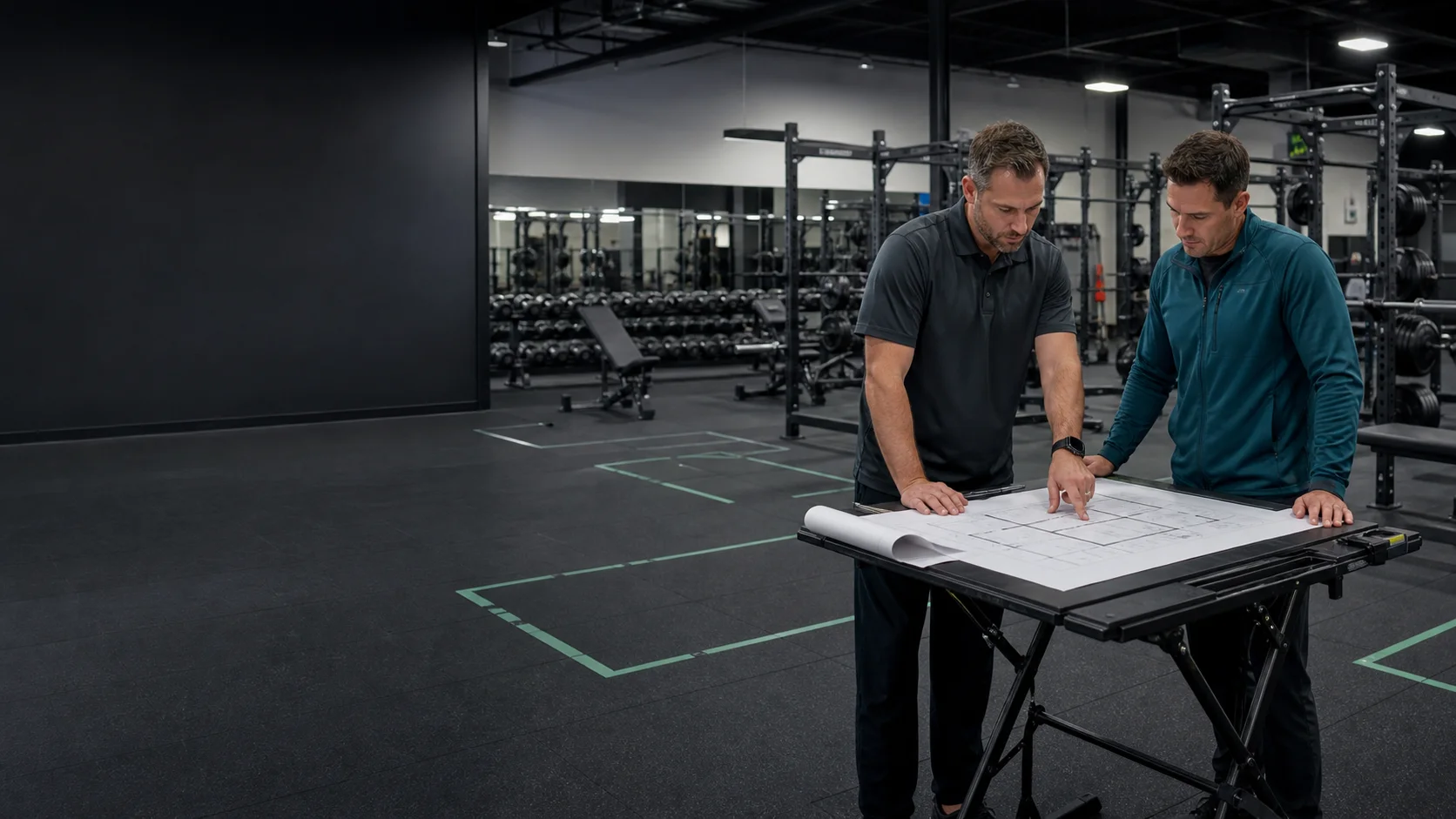
The bigger number came from clubs already open
The full equipment line moved from $256.1 million in 2024 to $310.1 million in 2025. The split behind that $54.0 million increase is shown below (Planet Fitness 2026a, 54).
Figure 1 · Reported company data
Where the $54.0 million increase came from
USD millions · One common 0–350 scale
- 2024 equipment revenue256.1
- Existing franchise clubs+47.4
- New franchise clubs+6.6
- 2025 equipment revenue310.1
47.4 ÷ 54.0 = 87.8% of the increase, not 87.8% of total equipment revenue.
Planet Fitness does not split the full $310.1 million between new and existing clubs, and the segment covers equipment—not mirrors or total renovation spending. So the $47.4 million is a timing signal, not a retrofit-market estimate.
New openings are easy to see. Replacement cycles, layout changes, and upgrades inside operating clubs are quieter. Anyone tracking demand only through opening announcements risks missing the second spending cycle that begins after the ribbon cutting.
A replacement cycle can reopen more than the equipment list
Planet Fitness makes that second cycle unusually visible. Under its current franchise agreement, clubs generally replace fitness equipment every five to nine years, depending on club volume, and refurbish and remodel in year 12 (Planet Fitness 2026a, 9).
Figure 2 · Disclosed lifecycle requirements
Opening is the start of the capital cycle
- Year 0Club opening and initial equipment
- Every 5–9 yearsEquipment replacement, depending on club volume and franchise agreement
- Year 12Required club remodel
Schematic milestones, not a time-proportional chart. Requirements vary by agreement. Interim layout changes are possible, not a disclosed universal schedule.
The schedule applies to fitness equipment and the broader remodel—not to a contractual mirror or wall replacement. An in-place equipment swap may leave the rest of the room untouched.
A layout change is different. Moving from cardio-heavy floors to larger strength and functional-training areas can affect circulation, sightlines, supervision, lighting, wall exposure, and finishes. That is when a project team may have a reason to reconsider choices that once looked fixed.
Strength training is changing the floor—and the buying window
The demand shift is visible beyond one company. In 2025, 81 million Americans held a fitness-facility membership, while U.S. gyms, health clubs, and studios recorded nearly 7 billion visits. Free-weight use—dumbbells, barbells, and kettlebells—had grown faster than any other equipment category since 2021 (Health & Fitness Association 2026a).
Planet Fitness has responded by reducing cardio’s share of the floor, adding more strength equipment, enlarging strength-training areas, and setting aside more room for functional workouts and stretching. The company said 95 percent of franchisees that opened or remodeled clubs in 2025 chose an optimized format; by year-end, nearly 80 percent of the global system had some version of an optimized layout or equipment offering (Planet Fitness 2026b, 2–3).
Those percentages are direction signals, not renovation rates. The first combines openings and remodels; the second can mean a layout or an equipment change. What they show is that the direction has spread through much of the system.
Figure 3 · Analytical hypothesis
When an equipment change may reopen wall scope
- Project triggerUsage pressure, format changes, or a lifecycle milestone
- Scope reviewConfirm whether layout, sightlines, or adjacent walls actually change
- DecisionIf scope reopens, define a controlled pilot; otherwise track the next real trigger
Author-developed reasoning, not a company-reported procurement process or a measured conversion probability.
Five questions separate a real project from a hopeful sales lead
A visible trend is not the same as a live opportunity. Before an operator tests a new system—or a supplier sends a sample—the project should answer five questions. We call this author-developed checklist TRACE. It is a commercial working tool, not an industry standard or compliance method.
- Trigger — Is there a real project?
Look for a date, budget, owner, approved brief, or brand directive. “We may renovate someday” is not a trigger.
- Reopened scope — Did the plan actually change?
Equipment replacement alone is not enough. The layout, wall exposure, circulation, sightlines, or functional requirement must be under review.
- Authority — Who can say yes, and who must live with the result?
Brand, franchisee, designer, contractor, facilities, operations, and risk teams may each control a different part of the decision.
- Controlled test — What must a pilot prove?
Agree on appearance, installation, downtime, cleaning, damage, rework, and acceptance before anything ships. “The sample looked good” is not a project result.
- Expansion — If it works, can it repeat?
Identify the next site group, the approval path, and the full cost of rolling it out—not only the material price.
If the first two answers are no, there is no live project. If the last three are unclear, the conversation is still early.
This filter can be applied to walls, flooring, lighting, acoustic treatments, and other choices affected by a remodel. It keeps suppliers from mistaking curiosity for demand and helps operators avoid approving a change that cannot be installed, accepted, or repeated.
A pilot should answer a project question, not decorate a sales conversation.
One operator is a signal, not the whole market
Planet Fitness is a useful mechanism case, not a stand-in for the whole industry. Operators have different formats, capital cycles, ownership models, and approval paths.
The wider installed base is still hard to ignore. An HFA-commissioned 2024 analysis reported 55,294 health clubs and studios in the United States (Health & Fitness Association 2024). The number does not tell us which sites are ready to renovate, but it shows why the installed base matters.
Life Time offers a second signal from a different business model. Its 2025 filing listed fitness-floor reconfigurations and center remodels among its modernization activities and separately reported maintenance spending for existing centers. Those categories include other work and are not a clean retrofit total. The narrower point is that mature operators continue to invest after a location opens (Life Time Group Holdings 2026, 44–45).
Taken together, the evidence supports a limited but useful conclusion: the United States alone has a large, heavily used fitness-club base; major operators are changing how existing floors work; and scheduled replacement or remodel activity can bring previous design choices back up for review.
It does not prove that retrofit spending exceeds new-build spending across the market, and it does not quantify demand for any individual product category. The clearest public evidence is U.S.-led, so the regional argument should be treated as a direction to investigate—not a finished market forecast.
Look past the ribbon cutting
New clubs will remain valuable. Every opening creates an initial fit-out and another location that will eventually need equipment, maintenance, and change. But the installed base grows older every year while member preferences and club formats keep moving.
The practical next steps are straightforward:
- Operators: map club age, re-equipment dates, lease renewals, brand refreshes, and planned layout changes across the portfolio.
- Designers and contractors: enter before the brief and drawings are fixed, when adjacent scope can still move.
- Suppliers: lead with the project trigger and acceptance path, not a catalog or product claim.
The next question is not only how many gyms will open. It is how many existing gyms are about to become new again.
In your last fitness-club renovation, what changed the brief first: equipment, member behavior, or the layout?
Published by NanoMirror Insights. NanoMirror is powered by Brisafe.
For commercial buyers
Understanding NanoMirror before you specify it
NanoMirror is Brisafe’s lightweight, film-based mirror category. Its reflective surface is not a conventional glass mirror sheet. Available formats include modular wall systems and movable mirrors. Choose the exact construction and mounting format for the project, not just the category name.
How is NanoMirror different from a glass gym mirror?
The key procurement difference is the construction and the work it requires. A lightweight finished module can simplify handling and avoid on-site glass cutting. Glass and film-based mirrors still need their own suitable mounting, surface care, visual acceptance criteria, and evidence for the selected assembly. A category name is not a test result.
Where is a lightweight mirror worth evaluating?
Consider it for gym retrofits, strength-floor redesigns, studios with changing layouts, and projects where handling or access is difficult. Wall-mounted modules and rollaway formats solve different problems. Confirm wall suitability, floor clearance, stability, and the supplied installation instructions before choosing.
Does a lighter panel guarantee a cheaper installation?
No. Lower product weight can change the handling plan, but labor savings and total cost must come from a site-specific quotation. Compare the same accepted area, performance, mounting kit, delivery, wall preparation, installation, and warranty responsibilities. The cost examples in our BOM article are hypothetical, not measured NanoMirror savings.
What should a distributor, contractor, or operator request?
Request the exact model and dimensions, net and packaged weight, compatible mounting or detachable base kit, installation and care instructions, relevant test reports, a production-equivalent sample, replacement availability, and written warranty responsibilities. For multi-site use, agree on a pilot and acceptance method before rollout.
Product descriptions are manufacturer-reported. These guides do not replace project-specific engineering, local-code review, testing, or a written quotation. NanoMirror Insights is published by Brisafe; it is not an independent testing body.
References and data note
- Health & Fitness Association. 2024. “The U.S. Health and Fitness Industry Is a $22.4 Billion Economic Powerhouse.” May 7, 2024. Read the source.
- Health & Fitness Association. 2026a. “81 Million Americans Were Members of a Fitness Facility in 2025, New HFA Report Finds.” April 9, 2026. Read the source.
- Life Time Group Holdings, Inc. 2026. “Annual Report on Form 10-K for the Fiscal Year Ended December 31, 2025.” U.S. Securities and Exchange Commission. Read the filing.
- Planet Fitness, Inc. 2026a. “Annual Report on Form 10-K for the Fiscal Year Ended December 31, 2025.” Filed February 25, 2026. U.S. Securities and Exchange Commission. Read the filing.
- Planet Fitness, Inc. 2026b. “2025 Annual Report.” Filed March 25, 2026. U.S. Securities and Exchange Commission. Read the report.
Public information was reviewed through August 20, 2026. Planet Fitness is used to show a company-specific mechanism; HFA provides industry scale and participation context; Life Time provides a second operator example. No public source reviewed quantifies North American fitness-mirror retrofit spending. Figures 1–3 are original visualizations derived from the cited public sources; Figures 2 and 3 include author-developed analytical inferences. No operator endorsement of NanoMirror or Brisafe is stated or implied.